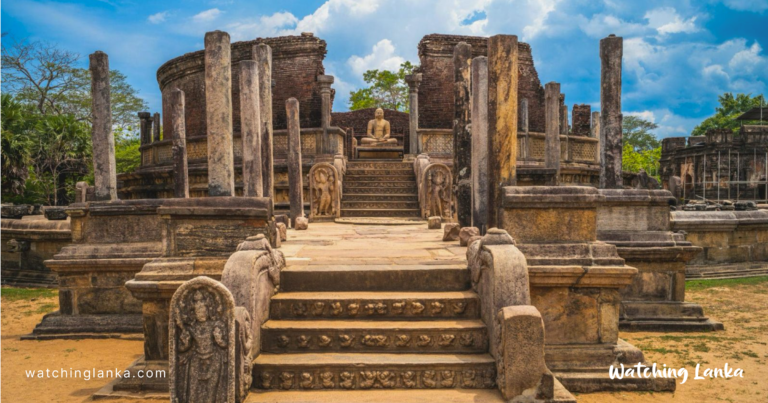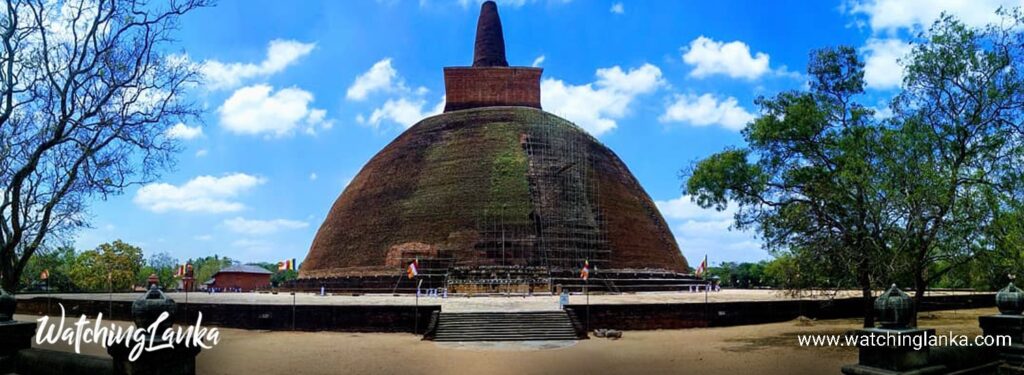
To the north of the city of Anuradhapura, the Abhayagiri Dagoba is revered by Buddhists as a stupa king, surrounded by garadi fences and moonstones carved out of great walls and ornamental ponds. This is also known as Uttara Maha Chaitya. It is said that King Walagamba built a stupa at the pla ce where the Buddha placed his foot after he ascended to Cyril. It is mentioned in the books of Fahien thero. According to the Saddharmaratnakara, a coffin in the shape of a bull is treasured here.
This is not just a complex. It was also a sect that maintained its own unique historical writing tradition and way of life. It was also an international center of Buddhist philosophy.
There is various folklore regarding the construction of this stupa. During the second period of King Walagamba, a Brahmin named Thea rebelled against the king. Mihindu Thera The first Brahmans to attain Buddhism in this country held a high position in society. After the establishment of the Bhikku Society, the place of the Brahmins was lost and the place was given to the Buddhist Bhikku. Around the same time, seven Tamil leaders landed in Ceylon with a large army. They fought with King Walagamba and defeated King Weda. The king left the throne and fled to the mountains. On the way, a Jain priest in the monastery near the north gate saw the king and shouted, “The great black Sinhalese is fleeing!”. Then the king said, “If the kingdom returns to me, I will make a monastery here.”
[envira-gallery id=”4568″]
Later, King Walagamba stayed in the hills, organized an army, and drove out Soline. One of his first tasks after becoming king, fulfilling the promise he made on the day of his escape, was to build the Abhayagiri Vihara on the site of the Giri Ashram. Kuppikala Mahatissa Thero was appointed as its leader in gratitude for the help rendered to the king by those monks during the reign of the invaders.
King Walagamba is also known as Wattagamini Abhaya. The Abhayagiri Vihara got its name from the name of King Wattagamini Abhaya and the name of the priest Giri who was in the Jain Ashram. The reign of Mahasen was the golden age of Abhayagiri. After the Tooth Relic of the Buddha was brought to Ceylon in the 4th century, Abhayagiri was chosen to be kept for public worship.
Although the state religion was Buddhism at the time, other indigenous religions, especially Hinduism, also had a significant influence, as evidenced by the architecture of the time.